
The global financial ecosystem has crossed a major threshold in its adoption of blockchain technology. Over the past several years, mainstream institutions explored decentralized networks through isolated testbeds and private pilot programs. Today, that experimental phase has concluded, giving way to production-ready enterprise systems operating around the clock.
As capital markets demand faster settlement, enhanced transparency, and continuous liquidity, institutional participants are shifting their focus to scalable network environments. At the center of this transformation is the deployment of tokenized assets, which are redefining how traditional financial instruments—such as money market funds, treasury bills, and commercial liquidity funds—are created, issued, and traded globally.
Why it matters
This story connects to Analysis, cryptocurrencies, Ripple and helps readers follow the wider crypto and market conversation with more context.
From Pilots to Production: The Light Switch Moment
For years, institutional engagement with distributed ledger technology (DLT) was characterized by cautious experimentation. Global banking institutions built permissioned proofs-of-concept to evaluate whether blockchain could streamline settlement workflows. However, these early initiatives often lacked inter-institutional liquidity and scalable network distribution.
Related: Analysis
That dynamic has experienced a decisive shift. Real-world financial assets are now being minted directly onto public and enterprise-grade ledgers, backed by robust regulatory compliance frameworks and institutional custody solutions.
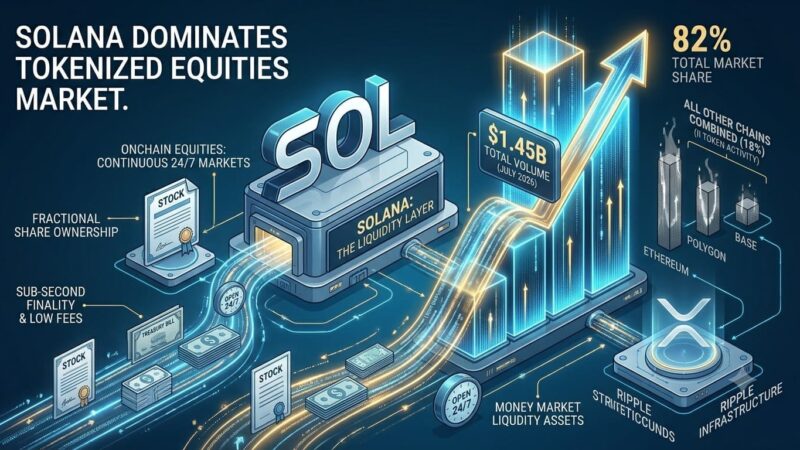
Related: Solana Captures 82% Market Share as Tokenized Equities Exceed $1.4B in July
According to Monica Long, President of Ripple, institutional adoption has reached a clear turning point:
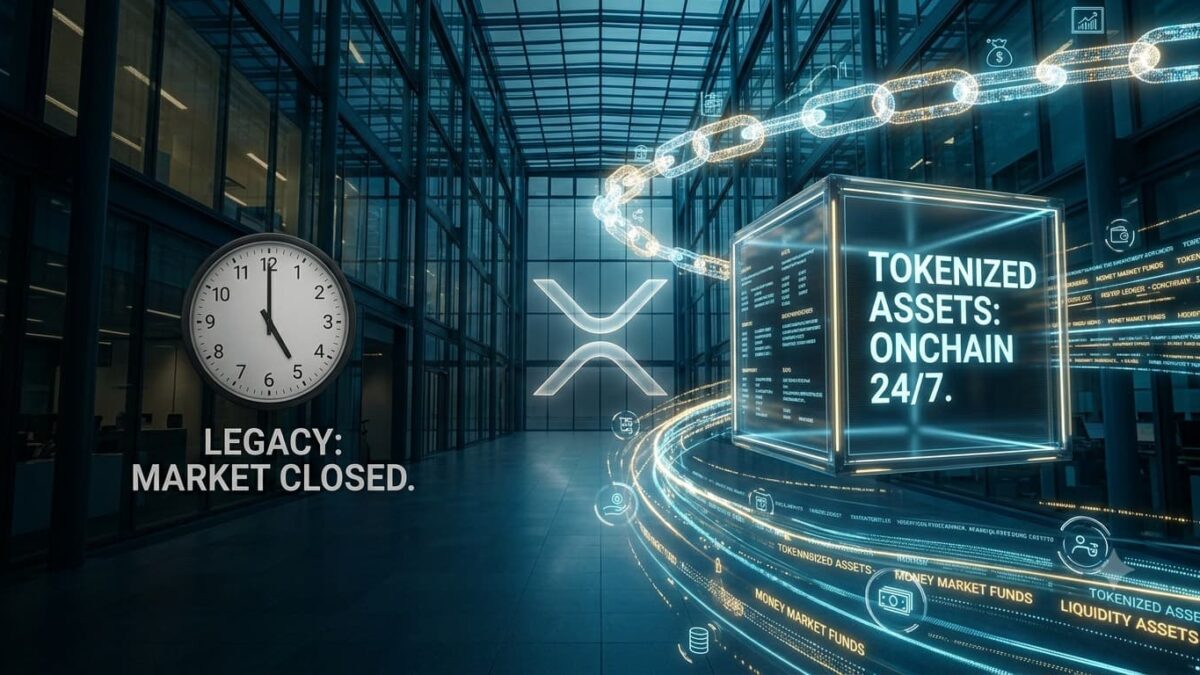
“In the last year, we’ve seen the veritable light switch flip – from bank pilots to production, from issuing tokenized assets like money market funds and liquidity funds to using them! Institutional capital markets are moving in one direction — onchain 24/7. At Ripple, our goal remains to provide the full stack of digital asset infrastructure – allowing institutional participants to take advantage of the entire lifecycle of a tokenized asset on the XRP Ledger.”
This evolution highlights a fundamental change in institutional mindset. The conversation has transitioned from asking whether blockchain is viable to evaluating how rapidly existing portfolios can be migrated onchain to maximize capital efficiency.
Why Institutional Capital Markets Are Moving Onchain 24/7
Traditional capital markets operate under legacy constraints: fixed settlement hours, multi-day reconciliation periods (such as T+1 or T+2), and complex chains of intermediaries. These legacy structures lock up capital unnecessarily and expose counter-parties to operational friction.
By migrating liquidity to distributed ledgers, financial institutions gain access to continuous 24/7 settlement capabilities. The key operational drivers accelerating this transition include:
- Instantaneous Settlement & Reduced Counterparty Risk: Blockchain networks execute transactions near-instantaneously, eliminating settlement delays and freeing up collateral that would otherwise be tied up in clearing systems.
- Automated Compliance & Smart Contracts: Regulatory parameters, identity verification, and transfer restrictions can be embedded directly into asset contracts, ensuring compliance at every stage of transfer.
- Fractional Ownership & Liquidity Management: High-value asset classes, such as private equity or debt instruments, can be divided into smaller digital tokens, opening secondary market liquidity for previously illiquid instruments.
- Enhanced Yield Efficiency: Financial institutions can utilize tokenized assets within decentralized or hybrid financial protocols to generate optimized yields on overnight liquidity and cash reserves.
Full-Stack Infrastructure: The XRP Ledger Advantage
For real-world assets to flourish onchain, financial institutions require more than simple asset issuance protocols. They demand an integrated ecosystem that encompasses secure token minting, compliant custody, decentralized exchange capabilities, and reliable cross-border liquidity bridges.
Ripple’s institutional roadmap addresses this requirement by developing a complete end-to-end stack on the XRP Ledger (XRPL). Built specifically for enterprise payment flows and institutional finance, the XRPL features built-in features designed for native token management, high throughput, low transaction fees, and minimal carbon impact.
       +-------------------------------------------------------+
       |             Institutional Capital Markets              |
       +-------------------------------------------------------+
                                  |
                                  v
       +-------------------------------------------------------+
       |       Ripple Digital Asset Infrastructure Stack       |
       |  - Secure Custody & Key Management                     |
       |  - Asset Tokenization Protocols                       |
       |  - Automated Compliance & Identity Verification        |
       |  - Liquidity Management & Cross-Border Settlement      |
       +-------------------------------------------------------+
                                  |
                                  v
       +-------------------------------------------------------+
       |            XRP Ledger (XRPL Layer-1 Base)             |
       +-------------------------------------------------------+
By providing institutional participants with native tooling for asset creation, management, and compliance, the XRP Ledger enables institutions to manage the full lifecycle of tokenized assets without friction.
Expert Opinions: Industry Perspectives on Onchain Migration
Industry leaders across both traditional finance and decentralized markets agree that the integration of DLT into capital markets represents an unprecedented evolution in global economic infrastructure.
Financial analysts emphasize that liquidity funds and money market products serve as the foundational building blocks for onchain banking. By placing money market funds on DLT infrastructure, financial institutions create a digital proxy for cash that earns yield while remaining usable as collateral across collateralized lending markets.
Furthermore, asset managers note that institutional DLT integration is transitioning from a defensive efficiency measure to an offensive growth strategy. Firms that adopt DLT infrastructure early gain access to global liquidity pools, automated treasury operations, and significantly reduced operational overhead compared to legacy competitors.
The Broader Impact on Real-World Assets (RWA)
The expansion of tokenized assets extends beyond money market funds and cash equivalents. The ongoing digital transformation covers a vast spectrum of real-world assets (RWAs), including:
- Government Debt & Sovereign Bonds: Treasury notes tokenized for instantaneous collateral pledging.
- Private Credit & Corporate Bonds: Direct debt issuance onchain, eliminating broker-dealer friction.
- Commercial Real Estate: Fractionalized property debt and equity structured for institutional portfolios.
- Commodities & Trade Finance: Digital representation of physical commodities to streamline trade settlement.
As institutional capital flows into these asset classes, the total value locked (TVL) in tokenized real-world assets is projected to expand exponentially over the coming decade. Network providers offering secure, enterprise-ready infrastructure are positioned to capture a significant portion of this institutional activity.
Outlook: The Future of Onchain Capital Markets
The transition of global capital markets onchain is no longer a distant theoretical model; it is an ongoing reality. As major banking networks, asset managers, and infrastructure providers expand their DLT footprint, the boundary between traditional finance and blockchain infrastructure continues to dissolve.
With institutional infrastructure developing rapidly on networks like the XRP Ledger, financial markets are heading toward a future defined by 24/7 liquidity, programmatic compliance, and global interoperability. For enterprise institutions, adopting robust tokenized assets capabilities is rapidly becoming an essential requirement for maintaining competitiveness in modern global finance.
Disclaimer: This article is for informational purposes only and does not constitute financial, investment, or legal advice. Digital asset markets are volatile, and regulatory frameworks remain subject to legislative updates. Always conduct independent research and consult a certified professional before making financial decisions.